
At the Norwich end of the Norfolk Saints’ Way, St. Julian’s Church, Mother Julian’s Cell and the Julian Centre (next door) are an obvious way station. How, I wondered, does a 21st Century pilgrim understand the vocation of an anchorite? How, indeed, does a 21st Century pilgrim understand pilgrimage? I have been much helped by a Blog entry by A Clerk of Oxford.
Anchorites were sealed into their cell (actually or symbolically), as if it were a tomb and for the rest of their earthly lives. With one window into the church and another open to the world beyond, an anchorites was a liminal person. Like the relics of a long dead saint they , themselves, occupied a threshold twixt the here and the hereafter.
In medieval times the pilgrim was also a liminal person. For the length of their pilgrimage they were excused the responsibilities of everyday life, in order to concentrate on the spiritual. They were excused the earthly, to pay attention to the heavenly.
St. Julian’s church, next to the docks in Mother Julian’s day, also occupied a liminal space. As church it was an outpost of the heavenly kingdom here on earth. On the dockside, it occupied a at a different type of liminal space. The sort common to all littoral (seaside) and riparian (riverside) places.
A pilgrim on the Norfolk Saints Way (littoral and riparian all the way), walks on the edge, by the water, from Burgh Castle to Norwich. Sauntering ( I love the word. It means to muse and I so want it to have been derived from the French sante terre :holy ground and to have been used to describe the liesurely travel of a pIlgrim) Suntering on this path, the pilgrim is free engage in Galilee Spirituality – fishing and talking to fishermen, walking by, sharing food and learning , considering flowers of the field and birds of the air, even climbing to a high places and all by the shore. And when you consider it seems that all of these activities are liminal in one way. or another.
Fursey and his brothers, who chose Burgh Castle as a base, were pilgrims. They had become pilgrims for the love of Christ leaving hearth and home never to return. Taking the Epistle to the Hebrews seriously, ” they had no abiding city but look to one that is to come.”
This same life long ideal of pilgrimage is promoted in Ancrene Wisse, a 13th Century handbook for anchorites, where the visiting of relics is contrasted with something deeper
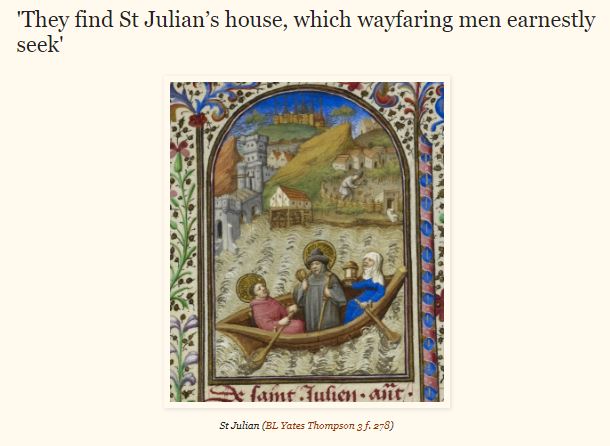
(Some)…. pilgrims travel with great labour to seek the bones of a single saint, such as St James or St Giles, but these pilgrims, who travel towards heaven, go to be made saints and to find God himself and all his holy hallows living in glory, and will live with him in joy without end. They truly find St Julian’s house, which wayfaring men earnestly seek.
(Translation by The Clerk of Oxford)
Most 21st Century pilgrims are unenthusiastic about old bones. We like the opportunity to walk through nature, space to sort our heads out and get some perspective on life. Many of us like to kneel where prayer has been valid and reflect on the experience of earlier generations. Some of us feel God comes close to us in our journeying. Sometimes our hearts burn within us on the road, and we catch a glimpse at the breaking of bread. And yet: more often there is a sense, he has gone before us; and though still warm, the nest is empty……… Each of our little pilgrim journey’s is sacramental (an outward and visible sign of something deeper, something spiritual), of our earthly pilgrimage – and here we have no abiding city but we look for one that is to come.







 The Walsingham Way