Voyage of the Bolero 2 : Berney Arms to Reedham for Water

Dawn broke silver and still on Monday morning.

DSCF0005 (3)


Our first task: to travel on the flood tide to Reedham for water. Passing Pokey’s Mill

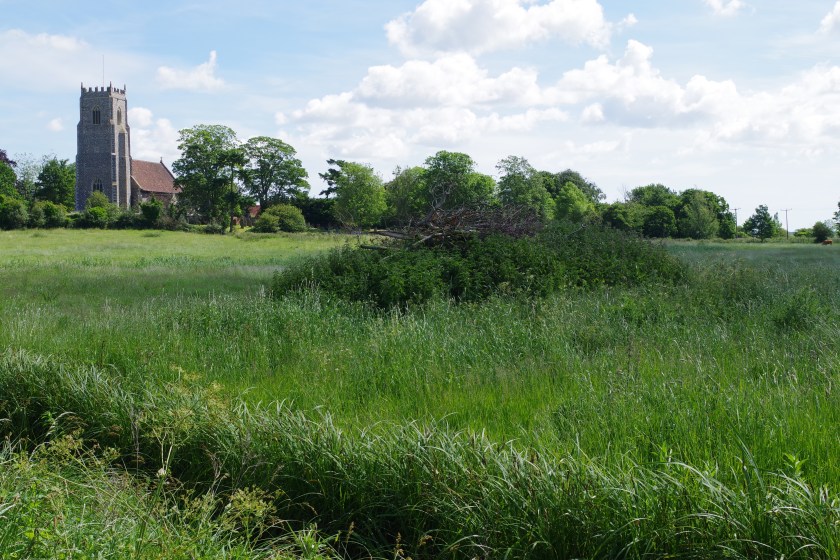
and glimpsing Felix’s Reedham Church, built into the Roman fort,

Before coming into Reedham through the railway swing bridge

Fortunately there was a free mooring.  Topping up the boats fresh water, gives one pause for thought. So often we take water for granted.

The life giving and death dealing properties of water occupied my mind. I wear my life-jacket as a mater of course! So many friends have drowned!  I think of :

  • The holy river Ganges, with the burning ghats beside it
  • Kipling’s Gunga Din, if I have my Hindi right, it translates as River of Life
  • and a dozen Biblical quotations – from the rivers in Eden to that in the Heavenly Jerusalem.

And then the rain set in for the day!

Voyage of the Bolero 2 : To Reedham Church and Back

On Pentecost Sunday we walked the two miles from Reedham Ferry to the Church

In Jesus’ day the  Feast of Pentecost  was celebrated in Jerusalem as the Barley Harvest Festival.  So it seemed entirely right that our path to the church IMGP7442

should take us through barley fields with grain beginning to ripen in the sun,

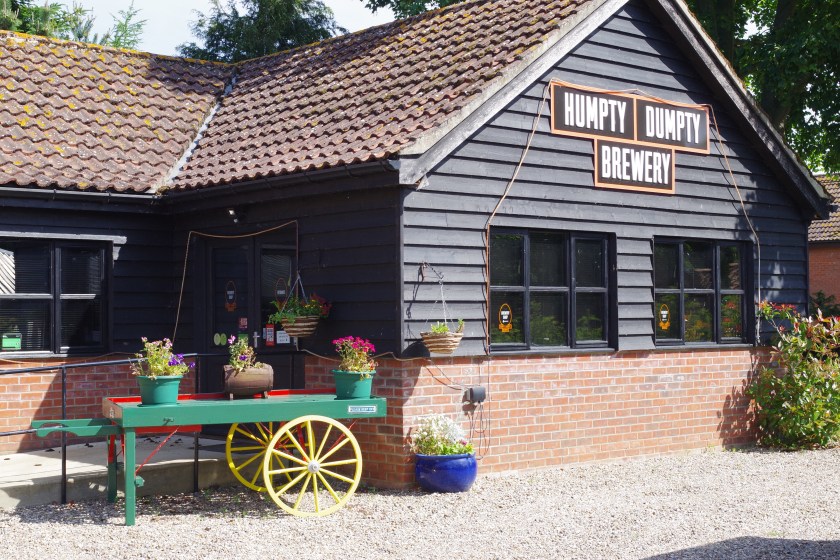
and the Humpty Dumpty  Brewery! 

IMGP7476

St. John the Baptist, Reedham is well worth a visit on any day.  I have lost count of the times I’ve visited but there is always something that catches my eye.  On this day it was Kati Cowen’s banner.  Made  1982,  after a fire that had left the church gutted ruin;  it is accompanied by an interpretation that draws attention to:  St. John the Baptist, the church burning , baptisms taking place (in the presence of a Heron with wind pumps background)  and Jesus depicted as the Light of the World and the Good Shepherd!

IMGP7462_edited-1

What more did I see on this Pentecost Sunday?  Felix, who had founded the Church in 7th C , with a bishop’s staff,  proclaiming Jesus (not church buildings).  Felix and his successors have been baptising East Anglians ever since;  and Pentecostal fire will continue to fall on the Church, if only we welcome the Holy Spirit!

Further, and this addresses the anxiety I feel about the future of Norwich Diocese’s 600 + medieval churches,  Church is not church buildings!  They could all burn down! Church is people!  “Something understood.”

Voyage of the Bolero 2 : Round trip to the Berney Arms

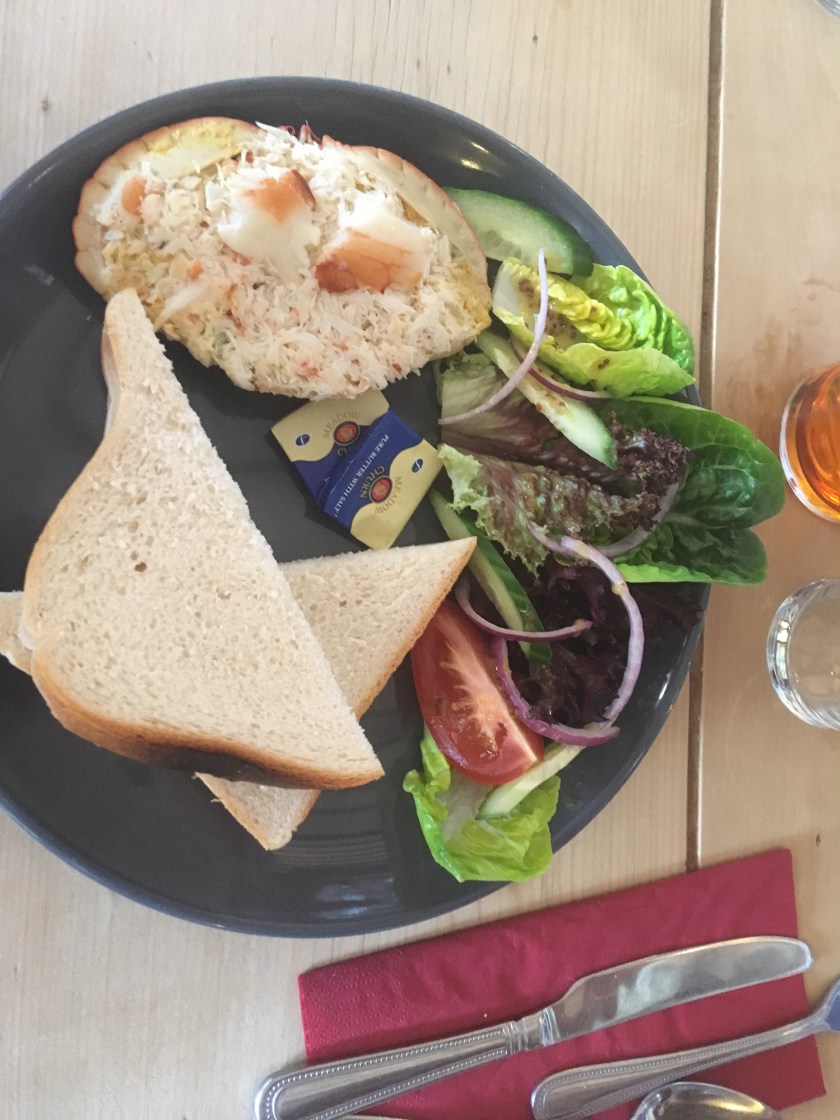
Bread and fishes for lunch with the family!   Then off to scout out Burgh Castle, the base for St. Fursey’s monastery in 7th C.

Bad news, the Broads Authority moorings at Burgh Castle are no more!  One might be able to negotiate moorings at the Fishermans  Inn  at Burgh Castle,  but we opted for a  sail-by.

Leaving Reedham, we took the he New Cut to St. Olaves.  We might have stopped there, except there were no moorings free,  otherwise we might have visited St. Edmund, Fritton and the remains of St. Olave’s Priory. We continued on our way down the River Waveney.

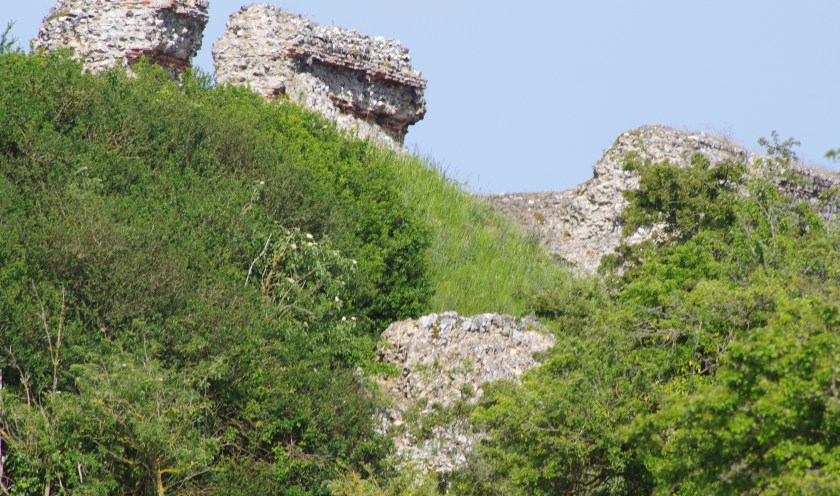
The Ven. Bede,  describing the site of St. Fursey’s monastery  at Cnobheresburgh, writes of “a wooded site, by the sea.”  Nobody knows for certain where Cnobheresburgh actually was! But Burgh Castle seems to have the best claim.  From  up-river, Burgh Castle certainly looks the  part!


IMGP7502


When  Fursey arrived the Saxon Shore fort had been long abandoned and grazing marshes around the inter-tidal mudflats of  Breydon Water were  open water – the  Great Estuary
imgp7504.jpg

The tumble down walls of the Roman fort are evidence that the fast running tides have scoured into the land. The north wall has completely disappeared!  The same scouring action of the tide has made the maintenance of safe moorings difficult.

Emerging into Bredon Water, we turned up the River Yare and, soon after, moored at the  Berney Arms (now, sadly closed!) Moorings.  There was no land here in the 7th C.,  halfway between st. Fursey’s  St. Felix’s Broadland bases . Burgh Castle to the south!imgp7529.jpg

Reedham, west, across grazing marsh where the towers of wind pumps line the riverbanks and  a line of church towers mark the higher land. Reedham church can be seen on the horizon beyond  Pokey’s Mill.
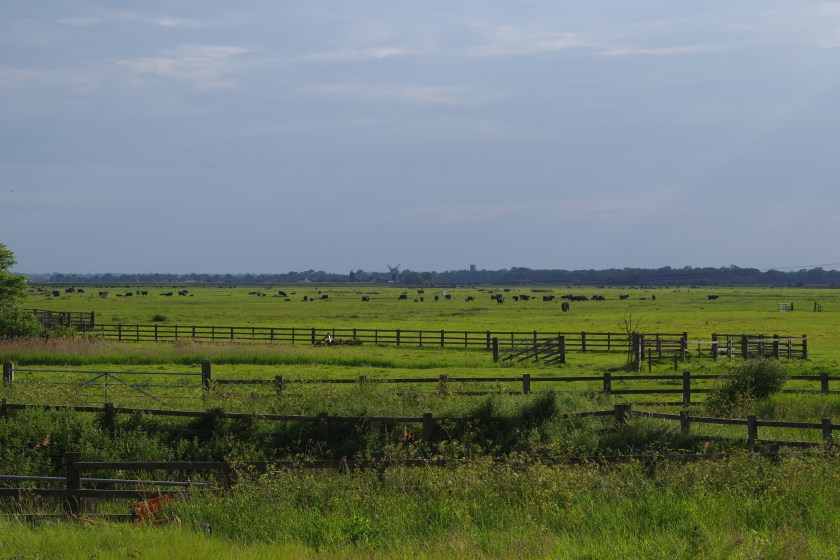
And to the east,  is the tower of St. Nicholas, Great Yarmouth!  Great Yarmouth was just a sandbank where fishermen dried their nets in the 7th C.
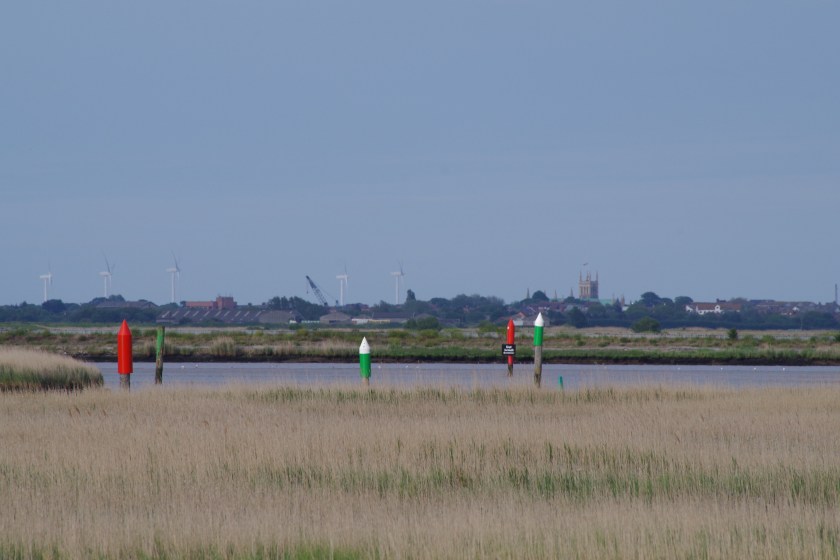
The trip from Reedham to the Berney Arms Moorings takes the pilgrim through The Breydon Water Nature Reserve.  There was plenty of time to consider the birds – Avocets, Redshanks, Lapwing,  Marsh Harriers, Oyster Catchers!  A walk from the mooring along the Wherryman’s or Weavers Ways will be rewarding.


Voyage of the Bolero 2 – Pentecost at Reedham Ferry

Long ago, when I was a merchant seaman, I developed the habit of making a spiritual communion if I could not physically get to Church.   This was going to be one of those Sundays. But the Sunday Service on Radio 4 helped me stay connected!  ++ Justin was the preacher.

He spoke  thoughtfully about language, culture and understating .  I found his thinking complementing my own.  I am much attached to Max Warren’s definition of mission: “Seeing what God’s doing and joining in”. The Holy Spirit, it seems to me, is the one who helps me see in new ways and to understand what was not understood.

The pilgrim journeys I make, including this cruise, hopefully take me to places that give me a clearer perspective on life, so seeing I can see; or to put it another way, to places where I can hear the still, quiet voice and listen to the silent music,  above the din – Babel/babble – of  our constantly connected,  24/7, 21st C lives.   The journeys to such  points of view and listening posts may be long,  or short.  Sometimes as simple as getting into that boat and going over to the other side .

On this Sunday morning dozens of cyclists were out on their bikes, some of them getting into a boat  crossing over to the other side right before my eyes – on Reedham Ferry!

Well, that’s something I hadn’t seen before!


Voyage of the Bolero (i) Brundall to Reedham

We picked up Broom’s Bolero 2 at their Brundall boatyard today. The weather was not promising. The boat is everything one could hope for! Incredibly comfortable for two who are used to more basic boating comforts!

Outward bound for Reedham, two hours down river, the intention is to cover the route of the Norfolk Saints’ Way by boat. We took a detour around Rockland Broad to consider the birds – Swans,  Marsh Harriers,  Reed Warblers,  Reed bunting,  Common Terns, Mallard,  Swifts,  House martins, Black-headed and Herring Gulls and Cormorants.

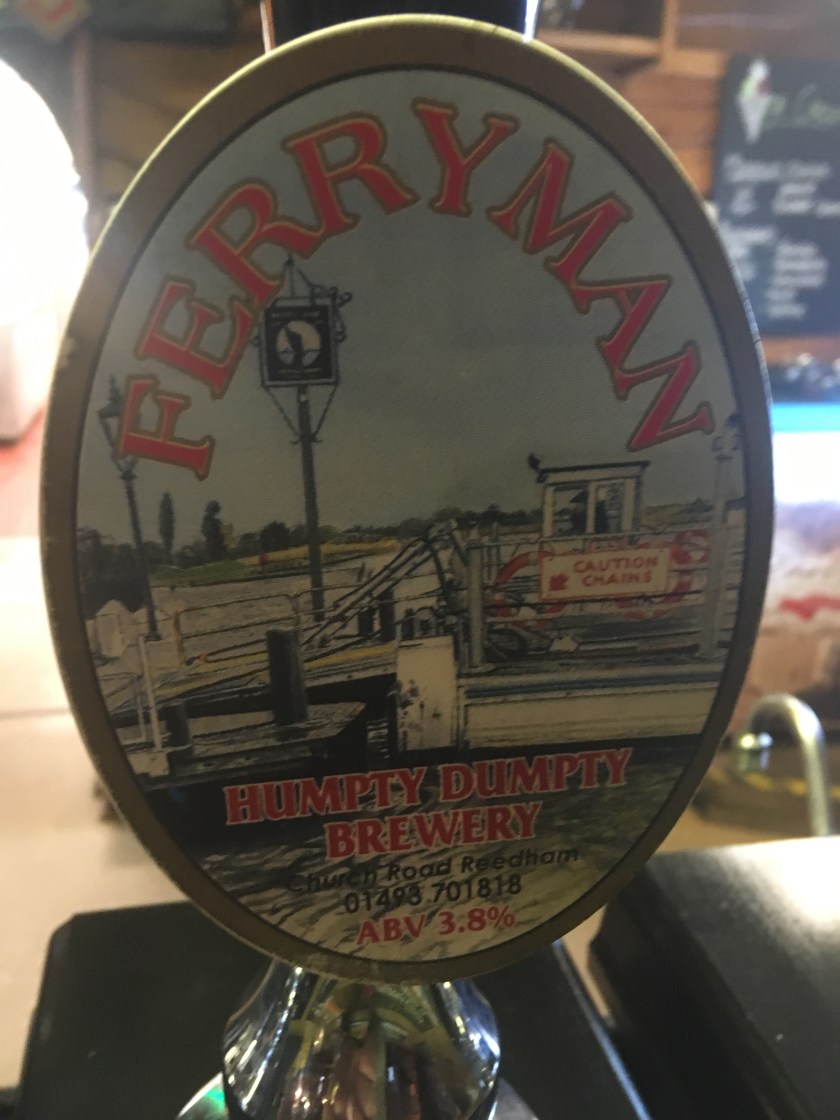
Arrived at the Reedham Ferry Inn ( where we had reserved a mooring) in time for a glass of something before supper.  A pint of Ferryman (re-badged for the venue, but really Little Sharpie), from the Humpty Dumpty Brewery – right next door to the church established by St. Felix in 7th C – and  the reason we are moored at Reedham.

The plan is to write something by way of a spiritual log as the cruise progresses.

Today,  I have taken some time to consider the birds; Christ-like, I have got into a boat and gone over to the other side, tonight I will sleep in the stern; tomorrow I will meet with friends and share a meal on the shore.  Tonight are with King Raedwald ( if it is he who is buried with his ship at Sutton Hoo) and death.

Paying the ferryman was an essential element of burial rituals then.  Raedwald’s burial assemblage included golden coins for the oarsmen that carried the sign of the cross. They were Christian, Merovingian coins.  But Readwald? Pagan? Christian ? Was he just hedging his bets, when it came to death?

And what of my death? Or yours for that matter! The tide is strong at Reedham. The tide of time runs swiftly too!

Mother Julian – 8th May (her feast day) II

The Rev’d Richard Woodham makes a mini-pilgrimage (continued):

I couldn’t help thinking,  as i passed the Lollards’ Pit on my way from Mother Julian’s cell to Norwich Cathedral for festal evensong,  “They would have been lucky to get a fire going on a day like today.  Rain stops play ? I don’t suppose so!”

One imagines the Black Death raised issues around the efficacy of the  sacraments for those who survived.  Could those who had come to doubt the value of Church rituals have grasped what Mother Julian had understood – that “Love was his meaning”?  Perhaps so!

But those who had condemned them to the stake seemed to have no understanding, at all!  At least, not of the understanding that sacraments are outward and visible signs of inwards and spiritual grace –  chief of which is Love!

Festal Evensong, sung at the heart of this place,  felt out of this world. By the time the procession had arrived outside the West Front, for final prayers before the statue of Mother Julian it had (miraculously?!) stopped raining.

“And All Shall be Well, And All shall be Well and All Manner of Things

shall be Well!” ?

I hope so!  I pray so!

Mother Julian – 8th May (her feast day) I

The Rev’d Richard Woodham makes a mini-pilgrimage:

On a wet afternoon,  I made my way to St.Julian’s Church and Mother Julian’s cell and sat in the quiet as heavy rain hammered on the roof and the sweet sound of a blackbird was heard from the wet garden.  In the church an organist practised for that evening’s High Mass; and a steady stream of visitors entered and shared with me in a companionable silence.

Listening to the echo of her revelation, I wondered about climate change and the shattered communities of Syria, Mozambique and India and persecuted Christians around the globe.

All shall be well ?!

I hope so!  I pray so! And remember the Black Death trauma she endured.


Picking up a hazel nut from the bowl by the door and lighting a candle by the statue of Our Lady  this pilgrim went out into streets that were as busy and as wet as they had been then.


Continued here 


New Archaeology – Monasteries and Bling

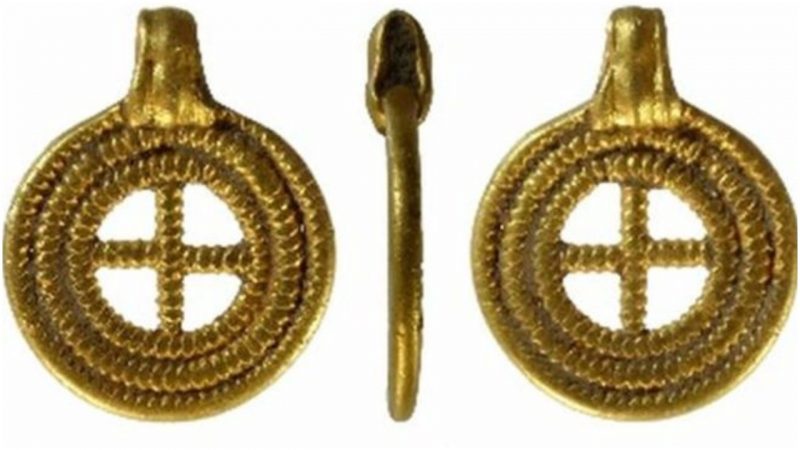
Picture from the Portable Antiquities Scheme

Recently declared as Treasure Trove this 7th Century gold pendant once adorned a high status Anglo Saxon lady. It was found close to the site that produced the amazing Winfarthing Pendant.

In case one imagined that extent of  Anglo Saxon ladies Christian commitment went no further than wearing posh jewellery, an impressive list of such ladies founded or ruled monasteries in the 7th Century.  In Norfolk , St. Withburga  founded a monastery at Dereham and her sister another on the Isle of Ely.

Now news has come from  Scotland that archaeologists have discovered the site of the 7th C double monastery at Coldingham, founded by St Aebba

12th March Feast of Gregory the Great

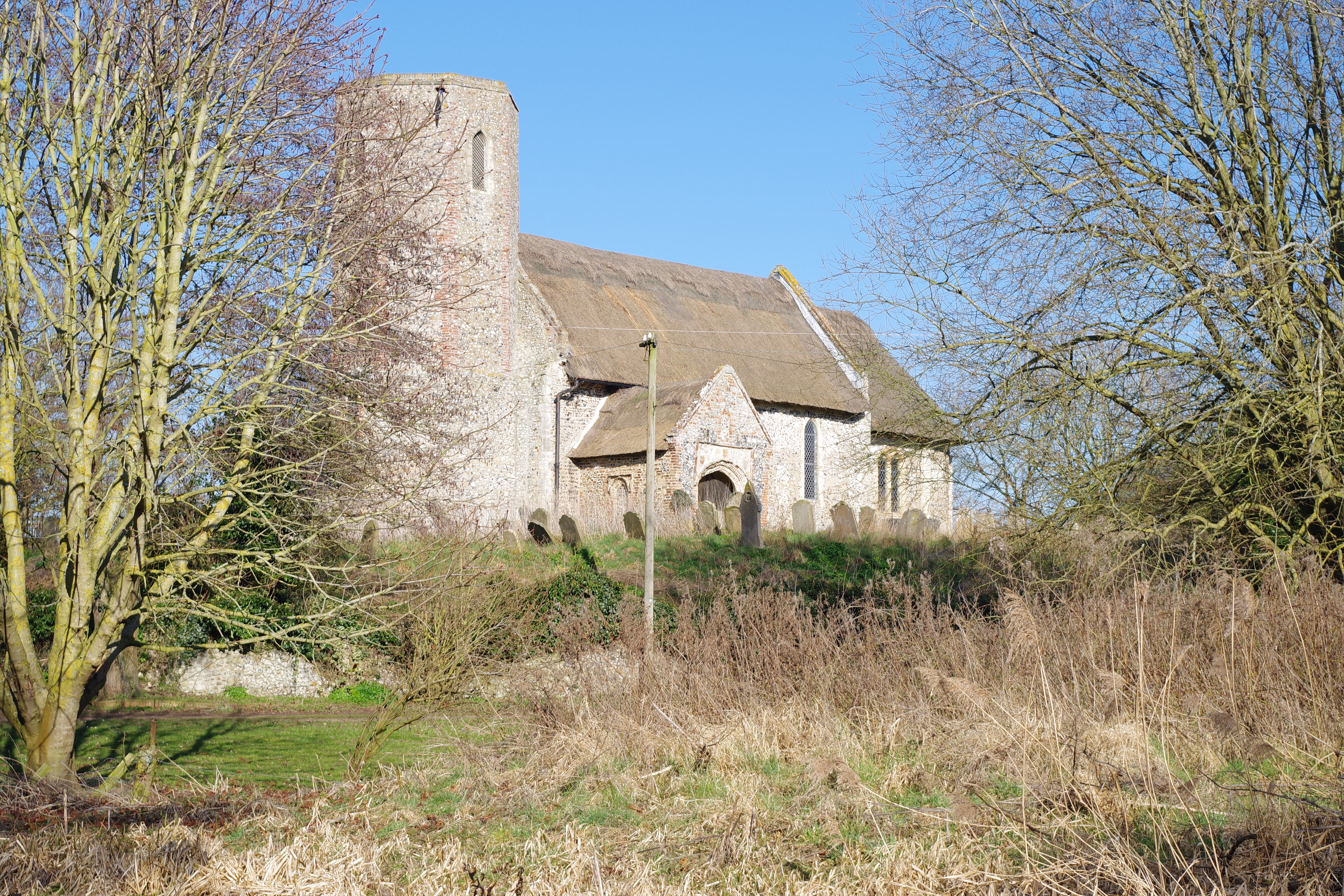
There are two churches dedicated to Gregory the Great on the Norfolk Saints’ Way – at Heckingham, now in the care of the Churches Conservation Trust; and at Norwich, in the care of Norwich Historic Churches Conservation Trust. Both are early foundations.

St.Gregory, Heckingham

“Our Gregory!” our Anglo-Saxon forebears called him. He was a great hero to the Ven. Bede. He begins Book II of his Ecclesiastical History England with

At this time, that is, in the year of our Lord 605,4 the blessed Pope Gregory, after having most gloriously governed the Roman Apostolic see thirteen years, six months, and ten days, died, and was translated to an eternal abode in the kingdom of Heaven. Of whom, seeing that by his zeal he converted our nation, the English, from the power of Satan to the faith of Christ, it behoves us to discourse more at large in our Ecclesiastical History, for we may rightly, nay, we must, call him our apostle; because, as soon as he began to wield the pontifical power over all the world, and was placed over the Churches long before converted to the true faith, he made our nation, till then enslaved to idols, the Church of Christ, so that concerning him we may use those words of the Apostle; “if he be not an apostle to others, yet doubtless he is to us; for the seal of his apostleship are we in the Lord.

Bede H.E. Book II Chapter 1
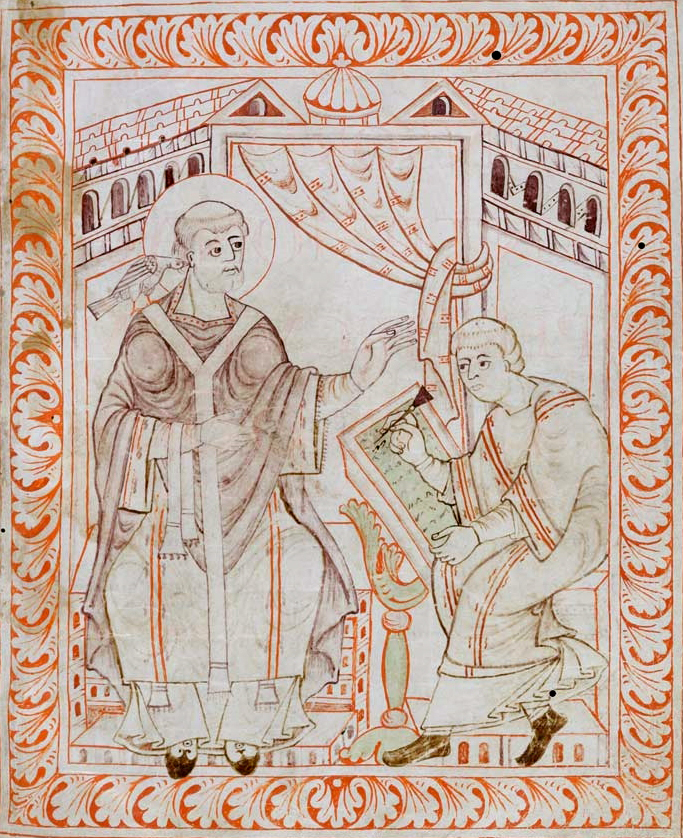
From Antiphonary of Hartker of the monastery of Saint Gall

Best known joke? Non Angli sed Angeli

It is said that one day, when some merchants had lately arrived at Rome, many things were exposed for sale in the market place, and much people resorted thither to buy: Gregory himself went with the rest, and saw among other wares some boys put up for sale, of fair complexion, with pleasing countenances, and very beautiful hair. When he beheld them, he asked, it is said, from what region or country they were brought? and was told, from the island of Britain, and that the inhabitants were like that in appearance. He again inquired whether those islanders were Christians, or still involved in the errors of paganism, and was informed that they were pagans. Then fetching a deep sigh from the bottom of his heart, “Alas! what pity,” said he, “that the author of darkness should own men of such fair countenances; and that with such grace of outward form, their minds should be void of inward grace.” He therefore again asked, what was the name of that nation? and was answered, that they were called Angles. “Right,” said he, “for they have an angelic face, and it is meet that such should be co-heirs with the Angels in heaven. What is the name of the province from which they are brought?” It was replied, that the natives of that province were called Deiri. “Truly are they De ira,” said he, “saved from wrath, and called to the mercy of Christ. How is the king of that province [pg 083]called?” They told him his name was Aelli;0 and he, playing upon the name, said, “Allelujah, the praise of God the Creator must be sung in those parts.”


Bede H.E. Book II Chapter 1

A Closer Look at the Cathedral Beasts

Norwich Cathedral North Transept

The three beasts above the Bishop’s Entrance together with the triangular headed arches and plain unadorned Romanesque doorway beneath have a distinct Anglo Saxon feel to them. As does the image of St.Felix that was fixed above the door on the outside . Are they wyms or dragons? At first sight the beast’s heads look quite benign. A closer look tells a different story.

The central beast looks almost perky!
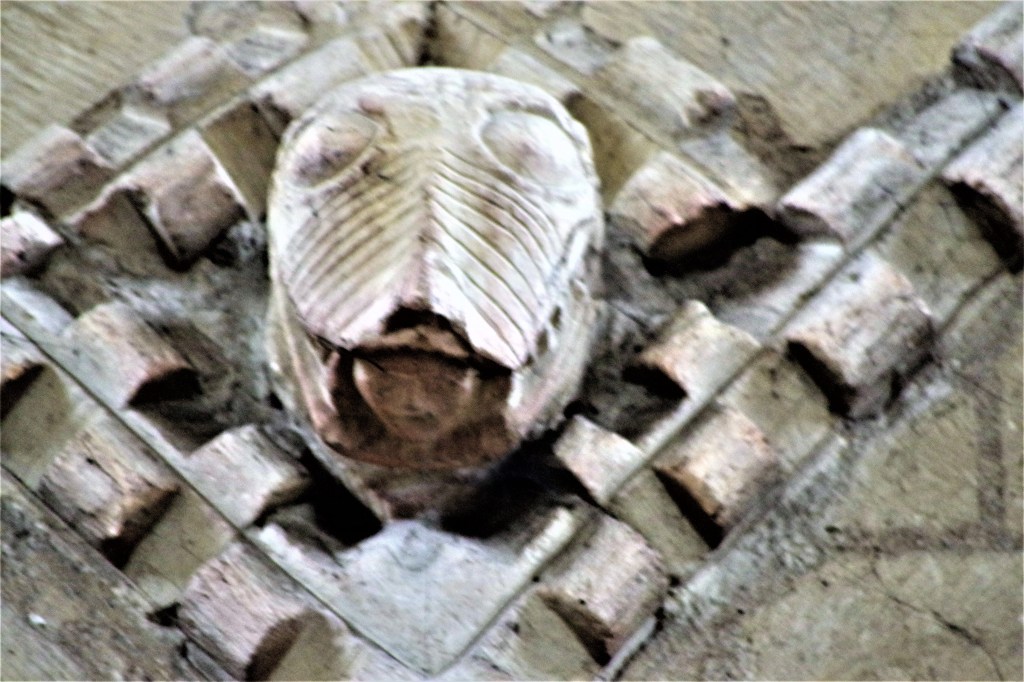
Grendel’s Dam? That’s a little face looking out of the mouth!
The dragon?
If so, this this fellow will be Grendel.